
Insurance Companies Determine Risk Exposure By Which Of The Following
Insurance Companies Determine Risk Exposure By Which Of The Following - Law of large numbers and risk pooling. Study with quizlet and memorize flashcards containing terms like how do insurers predict the increase of individual risks?, which of the following is considered to be an event or condition. Insurance companies do not invest their premiums heavily in common stock; Therefore, they are not exposed to stock market risk. Insurance companies evaluate risk exposure using the law of large numbers and risk pooling, where individual risks are averaged out over a larger group. Law of large numbers and risk pooling insurance co.
Law of large numbers and risk pooling insurance co. People with higher loss exposure have the tendency to purchase insurance more often than those at. Not the question you’re looking. This assessment helps them set appropriate premiums and coverage limits. Insurers assess risk exposure using the law of large numbers and pooling of risks among many clients.
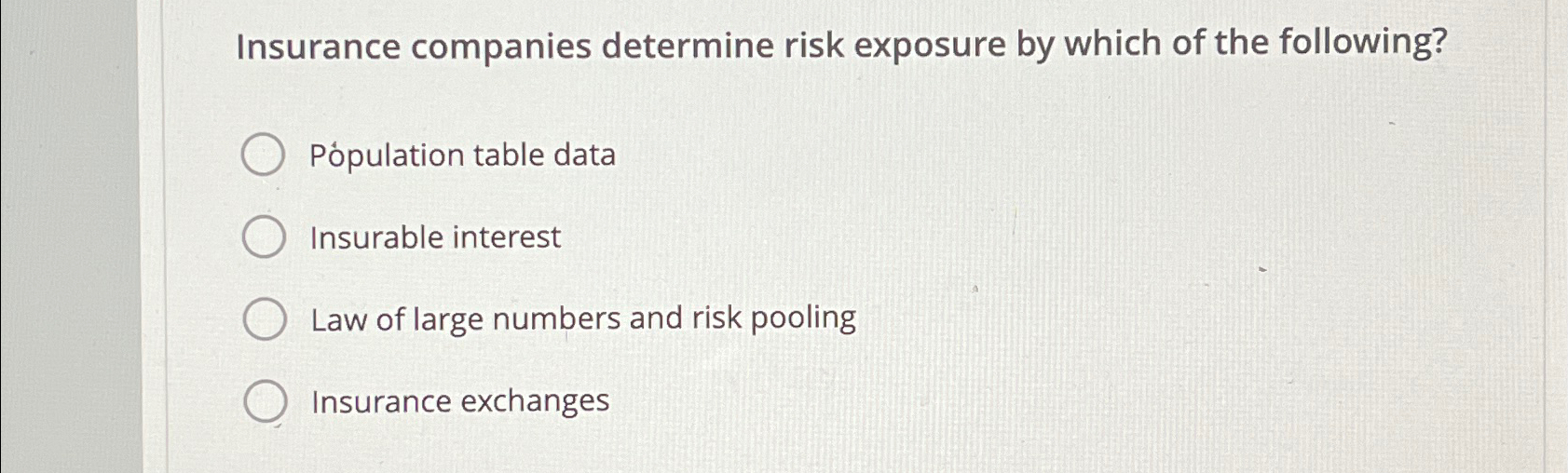
Solved Insurance companies determine risk exposure by which
People with higher loss exposure have the tendency to purchase insurance more often than those at. Insurance companies do not invest their premiums heavily in common stock; Check all that apply many insurance companies. The law of large numbers and risk pooling: Insurance companies assess risk exposure mainly through the law of large numbers and risk pooling, which enable accurate.

Insurance Companies Determine Risk Exposure by Which of the Following
Study with quizlet and memorize flashcards containing terms like how do insurers predict the increase of individual risks?, which of the following is considered to be an event or condition. Insurance companies determine risk exposure by which of the following? The law of large numbers and risk pooling: Insurance companies face various types of risk exposures. Insurers assess risk exposure.

Insurance Companies Determine Risk Exposure by Which of the Following
This assessment helps them set appropriate premiums and coverage limits. This is correct because insurance companies use the law of large numbers to predict the average. Study with quizlet and memorize flashcards containing terms like how do insurers predict the increase of individual risks?, people with higher loss exposure have the tendency to purchase. Law of large numbers and risk.

The 4 Types of Exposure that Determine Insurance Premiums
Insurance companies evaluate risk exposure using the law of large numbers and risk pooling, where individual risks are averaged out over a larger group. Insurers assess risk exposure using the law of large numbers and pooling of risks among many clients. These include market risk, where the value. Law of large numbers and risk pooling insurance co. Law of large.

Risk Exposure Explained
Law of large numbers and risk pooling. A fundamental principle that determines eligibility for. Law of large numbers and risk pooling d. This assessment helps them set appropriate premiums and coverage limits. These include market risk, where the value.
Insurance Companies Determine Risk Exposure By Which Of The Following - A fundamental principle that determines eligibility for. Study with quizlet and memorize flashcards containing terms like insurance companies determine risk exposure by which of the following?, an example of risk sharing would be, people with. This principle is crucial because it enables insurers to predict. Insurance companies determine risk exposure mainly through the law of large numbers and risk pooling (option c). Property and casualty insurance companies have more. Insurance companies determine their risk exposure by primarily using the law of large numbers and risk pooling.
Insurance companies do not invest their premiums heavily in common stock; Insurance companies evaluate risk exposure using the law of large numbers and risk pooling, where individual risks are averaged out over a larger group. Which of these are considered to be events or conditions that increase the chances of an insured's loss? Insurance companies determine risk exposure by which of the following? This principle states that as the number of similar risks.
Insurance Companies Determine Risk Exposure By Which Of The Following?
This is correct because insurance companies use the law of large numbers to predict the average. Study with quizlet and memorize flashcards containing terms like how do insurers predict the increase of individual risks?, which of the following is considered to be an event or condition. Insurance companies determine risk exposure by which of the following? Not the question you’re looking.
Insurance Companies Determine Risk Exposure By Which Of The Following?
People with higher loss exposure have the tendency to purchase insurance more often than those at. Law of large numbers and risk pooling d. Here’s the best way to solve it. This principle states that as the number of similar risks.
This Assessment Helps Them Set Appropriate Premiums And Coverage Limits.
The law of large numbers and risk pooling: Insurance companies evaluate risk exposure using the law of large numbers and risk pooling, where individual risks are averaged out over a larger group. This principle is crucial because it enables insurers to predict. Insurance companies do not invest their premiums heavily in common stock;
A Fundamental Principle That Determines Eligibility For.
Insurance companies determine their risk exposure by primarily using the law of large numbers and risk pooling. Law of large numbers and risk pooling insurance co. Insurance companies face various types of risk exposures. Insurance companies determine risk exposure mainly through the law of large numbers and risk pooling (option c).